
Customer + partner apps
Connect a customer request to the people fulfilling it, with defined status changes and operational visibility.
Booking · assignment · supportRIYADH BUSINESSES / PRODUCT DISCOVERY TO RELEASE
Turn a business idea into a defined Android and iOS release. Map the customer journey, partner workflows and operational tools before expanding the feature list.
India-based software engineering for Riyadh businesses. Remote delivery; no Saudi office or on-site team is represented.
Scope illustration—not a live project dashboard or promised delivery schedule.
MOBILE APP DEVELOPMENT / RIYADH
Web Cincture Private Limited offers mobile app development for Riyadh businesses, delivered remotely from India. The scope can combine Android and iOS apps, product design, backend APIs and the tools your team needs to run the service.
This page focuses on the decisions behind a first release or an existing-app improvement: which journey matters, who operates it, which dependencies can block it and how completion will be reviewed.
Explore Saudi-wide services, Arabic/RTL and integration planning ↗FIRST RELEASE / FOUR CONNECTED DECISIONS
For a Riyadh startup or business team, use the framework below to make the proposed release reviewable. It is a planning model, not a promise of a fixed launch date.
Describe the user, their starting point and the useful outcome they need to reach. Include unavailable, cancelled and failed states.
Example: request → confirmation → statusIdentify how requests are assigned, fulfilled, reviewed and supported. Decide who needs a partner app and who needs web-based tools.
Example: assignment → action → resolutionList data access, provider accounts, integrations, translations and approvals needed to complete the journey.
Example: account eligibility → test accessWrite tests for the journey, roles, language states and recovery paths. Agree who reviews the result and records acceptance.
Example: test case → outcome → reviewA BUYER’S SCOPE REVIEW
Use the same questions across suppliers. Different assumptions about roles, languages or integrations can produce estimates for very different products.
Android, iOS or both? Which devices and native capabilities are necessary?
Supported platform list and an SDK feasibility review.
Which users need an app, and which teams need browser-based administration?
Journey maps and a role-permission matrix.
Is Arabic/English required in the first release, and who approves translations?
Language inventory, RTL review and test criteria.
Who supplies account access, credentials and test environments?
Dependency list with owners and known constraints.
Who controls the code, store accounts, hosting and ongoing changes?
Written ownership or licence terms and support boundaries.
POSSIBLE APP SCOPES
These are development scenarios to discuss, not claims of projects delivered in Riyadh.
Connect a customer request to the people fulfilling it, with defined status changes and operational visibility.
Booking · assignment · supportCombine the essential mobile experience with APIs and the smallest useful operational layer.
Core journey · testing · feedbackAssess usability, source code and integration risks before choosing targeted improvements or a staged replacement.
Audit · change plan · continuityOWNED PRODUCTS / PUBLIC WEBSITE PREVIEWS
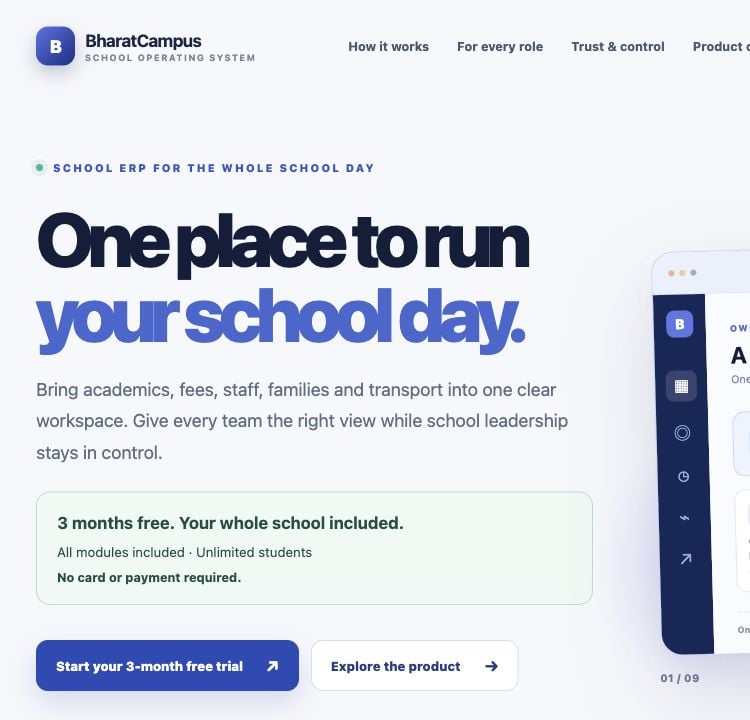
Explore how role-based systems and service journeys appear in our product portfolio. These examples provide context without representing Saudi customer references.
EDUCATION / CONNECTED ROLES
A school operating system illustrates why different users need clear access, connected workflows and consistent information.
Explore the platform ↗
MOBILITY / SERVICE OPERATIONS
Customer requests and mechanic-partner coordination show the operational work behind an on-demand service interface.
Explore the platform ↗Owned-product examples, not Saudi client deployments. Images are public website captures from 19 October 2026, not authenticated app screens. Visit each product for current information.
WORKING TOGETHER FROM INDIA
Agree Riyadh working-hour overlap and a named decision owner. Remote project coordination should make scope and blockers visible to both teams.
Review the product brief, journeys, language scope and acceptance criteria. Confirm what the client supplies and which dependencies remain unresolved.
Demonstrate the agreed workflow, record feedback and separate defects from scope changes. Track decisions rather than relying on informal message history.
Check user access, important device journeys, notifications and failure paths. Record remaining issues and the criteria for progressing to store preparation.
Confirm repository access, accounts, signing responsibilities and documentation. Separate defect support from ongoing maintenance or future feature work.
No fixed launch date is quoted here. Timing depends on the approved scope, access, review turnaround and external platform approvals.
RIYADH APP-PROJECT QUESTIONS
Understand the scope, delivery model and decisions that shape your app.
Yes. Riyadh businesses can discuss a scoped mobile app engagement with India-based Web Cincture. Agree a decision owner, review schedule, working-hour overlap and acceptance criteria. This page does not represent a Riyadh office or an on-site delivery team.
Start with one complete user journey, the operational tools needed to fulfil it and clear acceptance tests. Defer secondary features unless they are essential to delivering that journey. A useful MVP includes the necessary backend, permissions and exception handling, not only screens.
Those workflows can be included in one defined scope. Clarify which users need mobile apps, which teams need browser-based tools, and how assignments, statuses and access permissions connect. Each additional role affects design, testing and estimation.
Compare the same journeys, user roles, platforms, language coverage, integrations and acceptance tests. Check exclusions, dependencies, change control, handover and recurring costs. A lower price is not directly comparable when the scope or operational responsibilities differ.
Yes, subject to reviewing the source, architecture, access, dependencies and known issues. Agree the target improvements and transition risks before choosing targeted changes or a rebuild. Existing data, account access and release continuity need an explicit plan.
A timeline follows discovery and depends on scope, decision turnaround, integration access, testing and release requirements. Ask for milestone outcomes and dependencies rather than an unsupported launch promise. Store review time is controlled by the relevant platform.
No. The products shown here are Web Cincture portfolio examples. They illustrate role-based software and service-operation thinking, not Saudi client deployments, testimonials or proof of local market adoption.
LET’S DEFINE YOUR NEXT RELEASE
Tell us who the app serves and the workflow it needs to support. We can discuss the first release, dependencies and an appropriate next step.