
01 / WHAT CHANGES THE COST
Count the decisions.
Not only the screens.
Two apps can show similar interfaces and still require very different engineering work. A booking screen may depend on availability, partner acceptance, cancellation rules, location updates, payment states and an operations team. Define those behaviours before comparing development fees.
Platforms & devices
Android only, iOS only or both; supported devices, operating-system versions and accessibility requirements.
Roles & permissions
Customer, partner, employee and admin journeys; what each role may see or change.
Backend & operations
APIs, databases, admin workflows, notifications, reporting and recovery from failed actions.
Connected services
Payments, maps, OTP, existing business systems, AI services or device capabilities requiring integration work.
Connectivity & state
Offline requirements, synchronisation, real-time updates and handling interrupted or duplicate actions.
Quality & release
Design review, device testing, privacy requirements, release preparation and agreed acceptance evidence.
An estimate should state assumptions and exclusions. If a provider account, existing API or design input is unavailable, that dependency should be visible in the plan—not discovered at launch.
02 / CHOOSE THE FIRST RELEASE
A prototype is not
a finished application.
Choose the output that answers the immediate business question. Reducing the first release should remove optional scope, not hide essential work.
Prototype
Review screens and interactions before committing to a full build.
Confirm: whether data, payments and backend actions are simulated.
Working MVP
Deliver a focused, complete journey that real users can use and the business can operate.
Confirm: included roles, integrations and essential operational safeguards.
Production scope
Agree testing, deployment, privacy, recovery and operating requirements for the intended launch.
Confirm: acceptance criteria, handover and responsibility after release.
A working MVP can be production software. “MVP” does not mean that authentication, permissions or important error handling can be ignored. The correct scope depends on the users, data and consequences of failure.
03 / PLATFORM STRATEGY
Android and iOS.
Shared where it makes sense.
Building both platforms does not automatically mean twice the development fee. Shared-code approaches such as Flutter may reuse application work, while device integrations, permissions, testing and store requirements still need platform-specific attention.
A native approach may fit particular device features or an existing native codebase. A cross-platform approach may fit a coordinated Android/iOS release. Compare the requirements, integration risks, team capabilities and long-term maintenance—not a promised percentage saving.
Ask these questions before choosing the framework
- Which platforms do the intended users actually need at first release?
- Does the app depend on specialised device features or existing native code?
- Which integrations must be verified on real devices?
- Who will maintain the code, plugins and platform updates?
Read more about our Android, iOS and cross-platform development service or explore product strategy and discovery before fixing the implementation approach.
04 / COSTS BEYOND DEVELOPMENT
The development fee
is not the operating budget.
Ask for provider charges to be listed separately from engineering fees. Avoid comparing a development-only quote with a proposal that includes hosting, account setup or maintenance.
- Hosting, database & storageConfirm environments, usage assumptions, backups and who pays the provider.
- OTP, messaging & notificationsCheck provider setup and applicable per-message or usage charges.
- Maps, payments & AI servicesIdentify the required APIs, billing model, permitted use and integration owner.
- Developer accounts & releaseConfirm store-account ownership, current provider fees and submission responsibilities.
- Maintenance & further releasesSeparate agreed bug-fix coverage from ongoing support, OS updates and new features.
Provider prices and terms can change. This guide does not publish unverified price ranges or a fixed third-party bundle. Obtain current pricing for the selected providers and record the assumptions in the proposal.
05 / DELIVERY PLANNING
A milestone plan.
Not an unsupported deadline.
Timing depends on discovery, design decisions, implementation scope, integration access, client feedback and testing. Ask the team to identify what must be ready before each milestone starts.
- 01 / DEFINEScope & assumptionsUsers, workflows, dependencies and exclusions
- 02 / DESIGNReview the journeyInterfaces, states and operating decisions
- 03 / BUILDConnect the systemApp, backend, admin and agreed integrations
- 04 / VERIFYAccept & prepare releaseTesting evidence, handover and store preparation
App-store approval and review timing are controlled by the stores. Development completion is not a guaranteed public launch date.
06 / A BETTER QUOTE COMPARISON
Seven things to check
before approving a proposal.
- Complete user journeysWhat can each user finish, including cancellation, failure and support paths?
- Included platforms and systemsAre Android, iOS, backend, admin tools and integrations explicitly included?
- Milestones and acceptanceWhat working output is reviewed, and how is acceptance recorded?
- Client inputs and dependenciesWho supplies content, designs, provider accounts, API access and legal policies?
- Ownership and handoverWhat are the source-code rights, repository access, licences and account-transfer conditions?
- Costs and change requestsWhich fees are development, third-party usage or additional scope? How are changes approved?
- After-launch responsibilitiesWhat bug-fix coverage, support windows and maintenance work are agreed?
A useful first enquiry
“We need an Android and iOS app for [users]. The core journey is [start → action → completion]. We need [roles and integrations], and our existing system is [context]. We want a proposal covering [deliverables] with separate operating costs.”
Share requirements—not passwords, production credentials or confidential customer data.
Discuss a scoped proposal ↗07 / OWNED PRODUCT CONTEXT
App work connects
to real operations.
Web Cincture’s portfolio includes mobility and school-operation products. These examples show why roles, backend workflows and operating context matter; they are not price benchmarks or promises to reproduce a complete platform for an MVP budget.
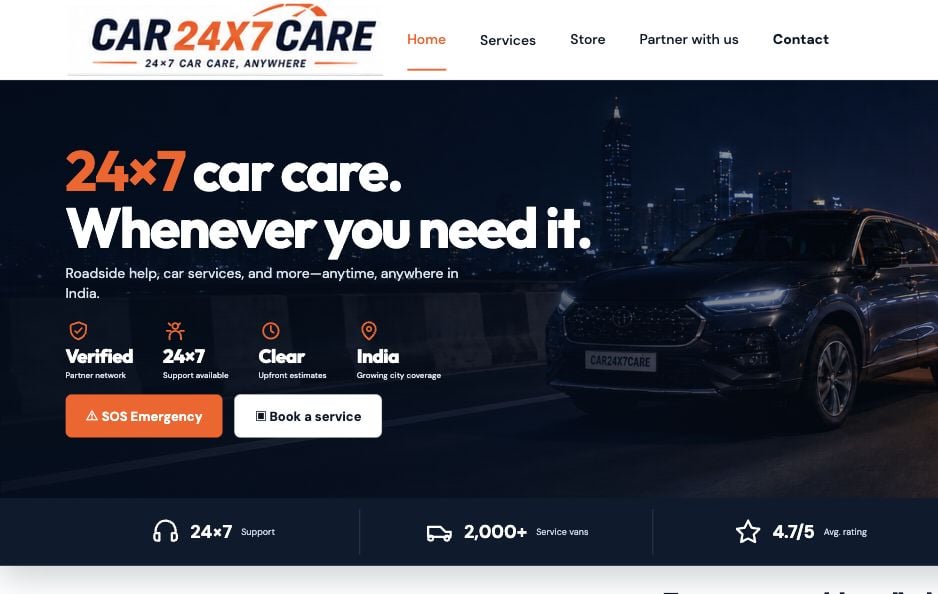
MOBILITY & SERVICE OPERATIONS
CAR24X7CARE
Customer and service-partner journeys illustrate why an app needs coordination behind the interface.
Explore the platform ↗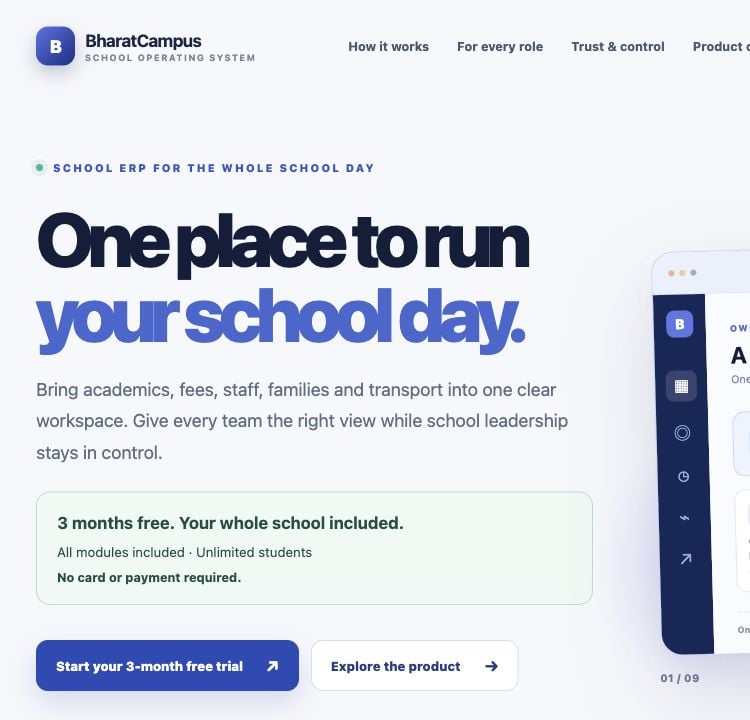
EDUCATION & SCHOOL WORKFLOWS
BharatCampus OS
Different school roles and information needs show why permissions belong in the initial scope.
Explore the platform ↗Images are public website captures from 19 October 2026, not authenticated app screenshots. Visit each product for current information.
08 / COMMON QUESTIONS
Before you budget
for the build.
How much does app development cost in India?
There is no single reliable price for every app. Platforms, user roles, workflows, backend systems, integrations and release requirements determine the development scope. Ask for an itemised proposal that separates development fees, provider charges and ongoing support. This guide is not a fixed-price offer.
Is an Android and iOS app twice the cost of one platform?
Not necessarily. A shared-code approach can reuse parts of the application, but platform-specific integrations, device testing, permissions and store preparation still require work. Compare proposals that explicitly include the same platforms and acceptance criteria.
Can Flutter reduce the cost of building an app?
Flutter can support shared application code across Android and iOS. Whether that reduces total delivery effort depends on the design, device features, plugins, existing systems and team expertise. Choose the framework around the requirements, not a guaranteed saving percentage.
What is the difference between a prototype, MVP and production app?
A prototype demonstrates an interaction and may not use a working backend. An MVP is a working first release focused on a complete core user journey. Production readiness adds the agreed operational, testing, privacy and release requirements; an MVP used by real users still needs appropriate safeguards.
Are backend and admin dashboard costs included?
Only when the proposal explicitly includes them. Confirm APIs, data storage, roles, permissions, admin actions, notifications and integration responsibilities. A mobile interface quote alone may not cover the system needed to operate the app.
Which costs continue after an app launches?
Depending on the scope, ongoing costs can include hosting, database usage, SMS or OTP, maps, storage, payment processing, AI services, developer accounts and maintenance. Ask who owns and pays each account, and check current provider pricing before agreeing the operating budget.
How long does Android and iOS app development take?
The schedule depends on the agreed scope, design decisions, integrations, client inputs and testing. Request a milestone plan with assumptions and acceptance criteria. Store review is an external dependency, so a development completion date is not a guaranteed public launch date.
Does Web Cincture build apps for businesses across India?
Web Cincture Private Limited is an India-based software and product engineering company offering Android and iOS app development, backend integration and related product work according to the agreed scope. Enquiries can be discussed remotely; location-specific delivery arrangements are confirmed separately.
About this guide
Published by Web Cincture Private Limited on . This is general project-planning guidance, not a quotation or a fixed delivery offer. Your agreement defines the actual scope, ownership, fees and support.
Explore related services: app development in Delhi NCR, SaaS engineering and backend and cloud integration.
Choosing the technology? Read our Flutter vs native app development guide.